Why now is the right time to review your commercial real estate portfolio, and how SBA financing can help you keep strong relationships in place.
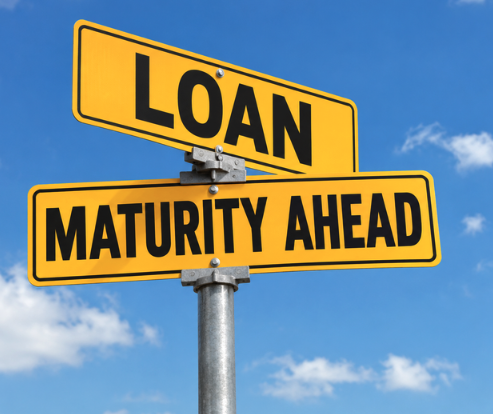
You’ve probably seen the phrase “maturity wall” in the headlines. It sounds dramatic, but the idea is simple: a lot of commercial real estate loans are coming due around the same time, and many of them were made when borrowing was much cheaper.
For lenders, that’s a challenge. It’s also a chance to get ahead of it.
Let’s Start With the Numbers
According to the Mortgage Bankers Association, $875 billion of the $5.0 trillion of outstanding commercial mortgages was scheduled to mature in 2026. That’s a lot of loans, and banks hold a big share of them.
Those loans also aren’t getting pushed down the road like they used to. Fewer are being extended, which means more borrowers and lenders have to decide what happens next: refinance, sell, or work something out.
Why Good Loans Can Still Get Stuck
Here’s a simplified example.
Five years ago, a business owner bought their building with a $2 million loan at 4 percent. Their monthly payment was about $10,500, and the business handled it easily.
Now the loan is coming due, and they still owe about $1.75 million. The business is doing just as well, but rates are higher. At 7 percent, that same monthly payment only supports about $1.5 million in debt.
That leaves a gap of roughly $250,000. Nothing went wrong with the business. The math just changed.
One Way to Close the Gap: The SBA 504 Loan Program
If your borrower owns and occupies their building, the SBA 504 program may help.
Think of an SBA 504 loan as splitting the financing into two pieces. Your bank makes the first loan and keeps the first lien position. B:Side makes the second loan, backed by the SBA. The borrower puts in the rest, and their down payment is often smaller than a conventional loan would require. For a refinance, the borrower can use equity they have in the property towards their required down payment.
What that means for lenders:
- Less exposure: Your bank isn’t carrying the whole loan on its own.
- You keep the relationship: Your borrower stays with you instead of walking out the door.
- CRA credit: SBA 504 loans may count toward your Community Reinvestment Act goals.
- Long-term fixed rate: The SBA portion carries a fixed rate for up to 25 years, which helps your borrower lock in predictable payments even when rates are moving.
The SBA 504 program can be used to refinance existing debt, with or without new expansion costs, and SBA has made its refinancing options more flexible in recent years. Every loan is different, so eligibility comes down to the property and any new costs, the business, and the existing debt.
Your Next Step: Take a Look at Your Portfolio
The earlier you spot a refinancing gap, the more options you have. We recommend starting the conversation six to twelve months before a loan matures. That gives everyone time to pull financials, order an appraisal, and confirm eligibility without a last-minute scramble.
Here’s a quick way to start:
- Pull a list of owner-occupied CRE loans maturing in the next 12 to 24 months.
- Flag any that were written when rates were much lower.
- Send them our way. We’ll help you figure out which ones could be a good fit for an SBA 504 loan.
If you have loans coming up and you’re not sure how they’ll refinance, our team is happy to walk through them with you. Contact your local Client Relations Officer.